

How Big Is Texas’ Success? A Look at 2025
“It’s almost kind of embarrassing for the rest of the U.S.” —Pia Orrenius, Dallas Fed


Individual successes, especially when numerous, generally imply that the environment is conducive to achievement or at least doesn’t hinder it. (In all likelihood, someone, at some point, fought to make the environment more favorable to success—see the Texas Revolution.)
Texas is a very good example. The Lone Star State has been booming in all positive directions over the past decade, due in large part, but not only, to the state’s policies, which favor entrepreneurship, risk-taking, low taxes, fewer regulations, and an overall higher standard of living—where you want to start a family and a business. The other major reason is, of course, its people, who are gritty, enterprising, self-reliant, resilient, and of a free spirit, though kind.
Let’s review a few key numbers highlighting Texas’ successes and milestones in 2025.
If Texas were (again) its own country, it would be the 8th economy in the world (9th if California were also its own country) with a GDP of $2.9 trillion in 2025, ahead of Italy, Russia, and… New York. Texas is right behind France, which has a GDP of $3.4 trillion. As we’ve seen before, not only is it just a question of time when Texas will overtake France, but even the French admit it! Texas’ GDP per capita is already $88,000, compared to France’s $46,000. In 2025, Texas’ growth was 4.09% (compared to about 2% in the United States and 0.7% in France).
In a Dallas Morning News article published yesterday, Pia Orrenius, a vice president and senior economist at the Federal Reserve Bank of Dallas, is quoted as spelling out Texas’ success related to GDP growth in no unclear terms: “it’s almost kind of embarrassing for the rest of the U.S.”
[Pia Orrenius] then addressed gross domestic product, the value of everything produced in the economy. The gap there has been even more striking in recent decades. In measuring growth by GDP, “it’s almost kind of embarrassing for the rest of the U.S.” because the difference in Texas’ favor appears to be widening, she said.
Orrenius also highlighted the role that policy plays:
She highlighted Texas’ “open and flexible markets.” The state leans on “relatively low taxes and less regulation” to attract companies and capital, and she said it comes in below the national average and high tax states such as California and New York on per capita state and local tax burden.
A booming economy is home to more opportunities at all levels. Here are some numbers:
Texas led the nation in job creation, with 132,500 jobs created in the past year and an unemployment rate of 4.3%.
Texas was again ranked as the best state for business in 2025—that’s 21 years in a row—with 314 HQ relocations to Texas between 2015 and 2024.
There are 54 Fortune 500 companies in Texas and more than 3.5 million small businesses.
According to a Partnership for New York City report on Texas’ competitive edge, “financial services recruitment in Texas surpassed New York’s with 9% more job postings in 2025” and “Texas’s financial services sector grew faster over the decade, with [gross regional product] rising 121% compared to New York’s 72%.7.” (Of the 314 HQ relocations in the past 10 years, 23 were from New York.)
Texas isn’t just booming in financial services. Texas cattle herds represent 14% of the U.S. cattle population. The state has 230,662 farms and ranches over 125.4 million acres.
In 2024, Texas was the largest exporter of goods in the United States, with $455.0 billion in goods exported worldwide.
Texas added 390,000 residents in 2025, more than any other state.
Texas was the second state with the most marriages in 2025, right behind California, with a little more than 175,000 weddings. Texas also had the second-highest number of births, with 278,000 babies born.
This is but a snippet of Texas’ successes in 2025. Of course, despite being sometimes advertised as the Texas Miracle—and although I do agree that God blessed Texas—these achievements are the result of hard-working Texans and sound economic policies.
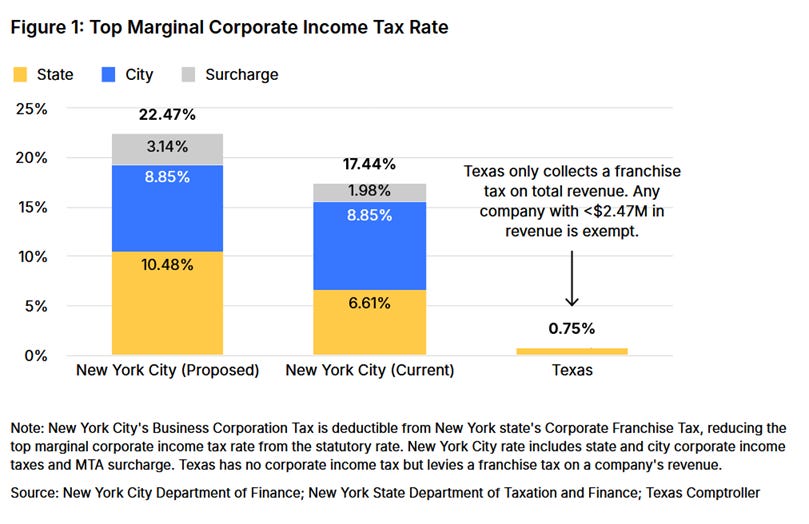
We’ve compared Texas’ policies with California’s and France’s so far. The Partnership for New York City report on Texas’ competitive edge draws a comparison focused on financial services in Texas vs. New York, and what Texas did to attract more of these… out of New York. The following chart is telling.
Speaking of financial services, their expansion in Dallas earned the city the nickname “Y’all Street”—which could well dethrone Wall Street in the future.

Finally, Texas now has three stock exchanges: the Texas Stock Exchange, the New York Stock Exchange Texas, and the NASDAQ Texas. The latter was officially launched on March 5, 2026, in front of the Alamo.
The sky is the limit in Texas.